A Snowfall, A Slip… and Sudden Paralysis
A Story of Cervical OPLL, Trauma, and Hope
What began as a joyful holiday in the hills of Shimla turned into a life-altering moment within seconds. He had travelled there to enjoy the snow — laughter, photographs, snow games. Like many others, he slipped while playing. It seemed like a simple fall. But when he tried to get up… he couldn’t.
He was unable to move his arms.
He was unable to move his legs.
Soon after, he lost control over his bowel and bladder.
In the blink of an eye, an active and healthy man was rendered completely paralyzed.

The Week That Changed Everything
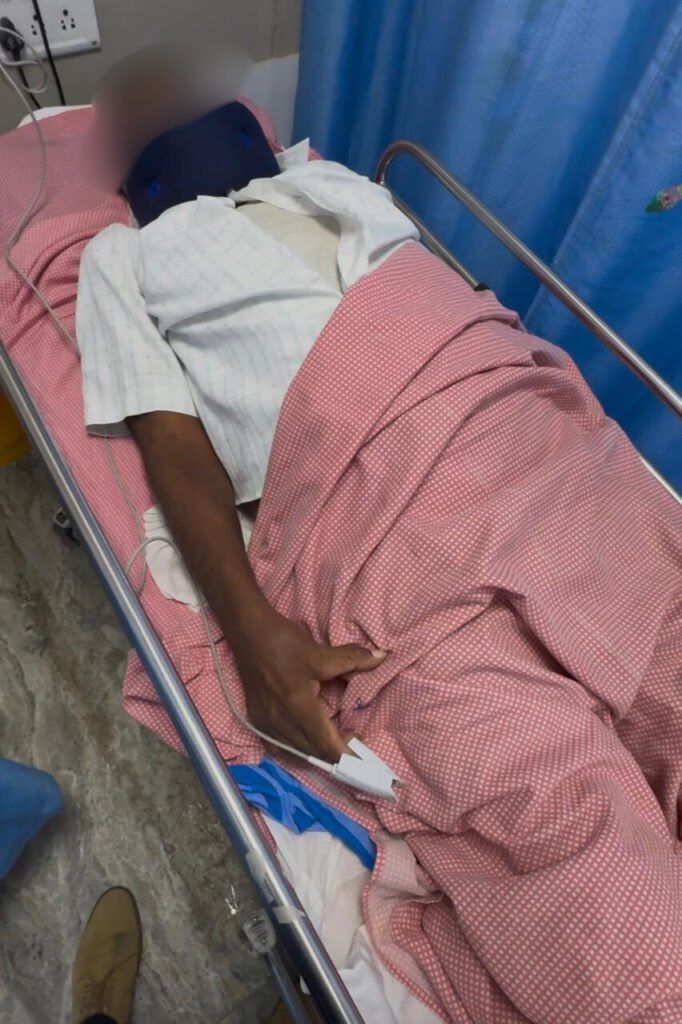
Due to the location and logistical challenges, he reached us one week after the injury. When I first saw him, he lay still — completely dependent, frightened, and unsure of what his future held.
On examination, he had:
- Paralysis of all four limbs
- He was wearing diaper and had urinary catheter (beacuse he had no control over his stools or urine)
For any spine surgeon, this is one of the most devastating presentations to encounter.
The Hidden Problem: OPLL
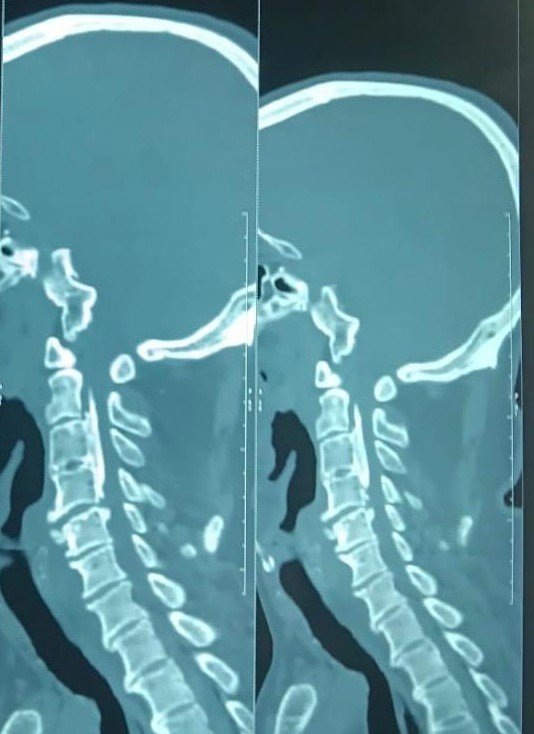
His scans uncovered the reason why a seemingly minor fall resulted in a catastrophic injury. He had extensive Ossified Posterior Longitudinal Ligament (OPLL) from C2 to C6 — a condition where a ligament inside the spinal canal slowly turns into bone. Over time, this had already severely narrowed his spinal canal. The spinal cord was living in a critically tight space. The fall did not just injure him — it was the final trigger in a spine that had no reserve space left.
The Surgical Decision
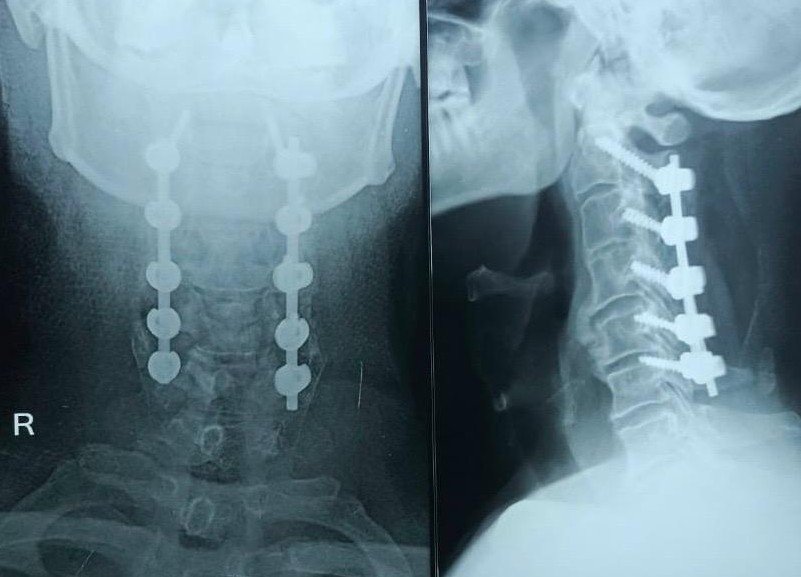
In cases like this, every minute matters — but even after a week, decompression can still make a difference. We planned an urgent: C2–C6 Laminectomy with Lateral Mass Fixation
The goals were clear:
- Relieve pressure on the spinal cord
- Give the cord space to breathe
- Stabilize the spine
- Prevent further damage
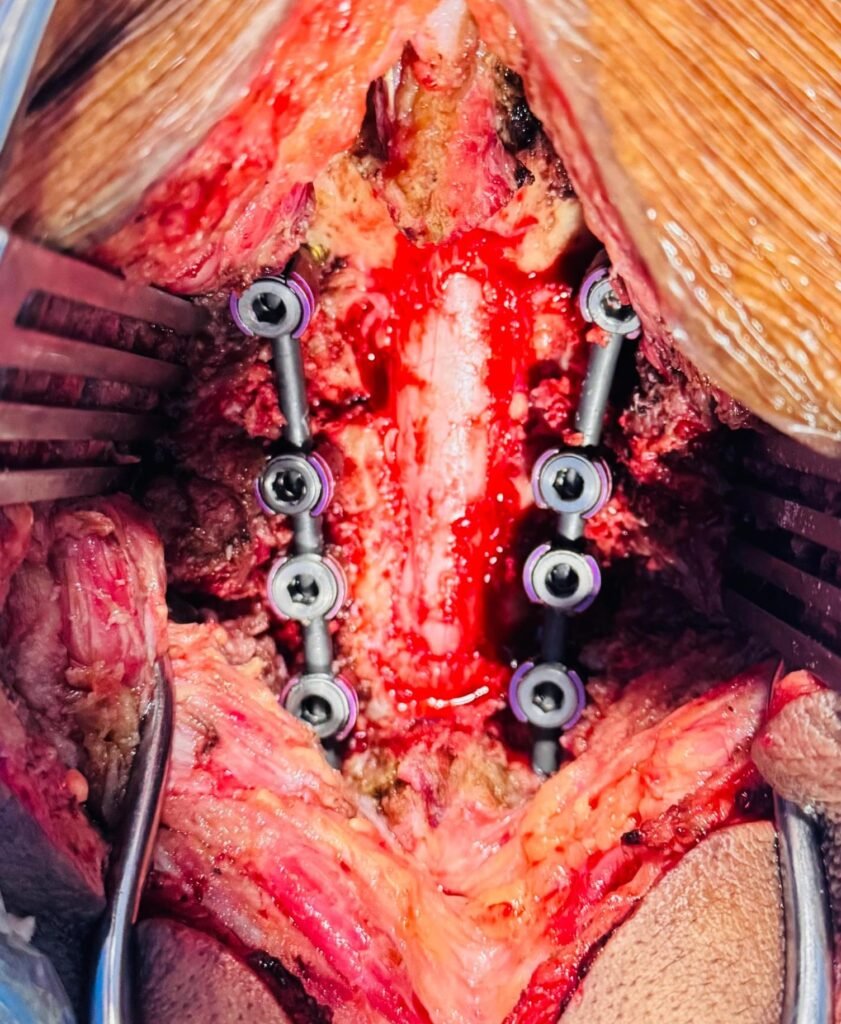
The surgery was meticulous. The compression was severe. The cord was under obvious stress. Once decompressed, the spinal cord slowly expanded posteriorly — a moment every spine surgeon hopes for in such cases.
The Emotional Side of Spine Surgery
Behind every scan is a person. Behind every surgery is a family waiting outside the OT doors. His relatives asked the question we hear so often: “Will he walk again?”
In spinal cord injuries, the answer is never absolute.
Recovery depends on:
- Severity of initial injury
- Cord signal changes
- Timing of decompression
- Postoperative rehabilitation
But what we can always offer is the best possible chance.
The Moment That Changed Everything
The next morning, we assessed him carefully. He was able to move his all four limbs without any assistance. We encouraged him. Supported him. And then — We made him sit.
Then stand.
And then, with assistance…
He took steps.
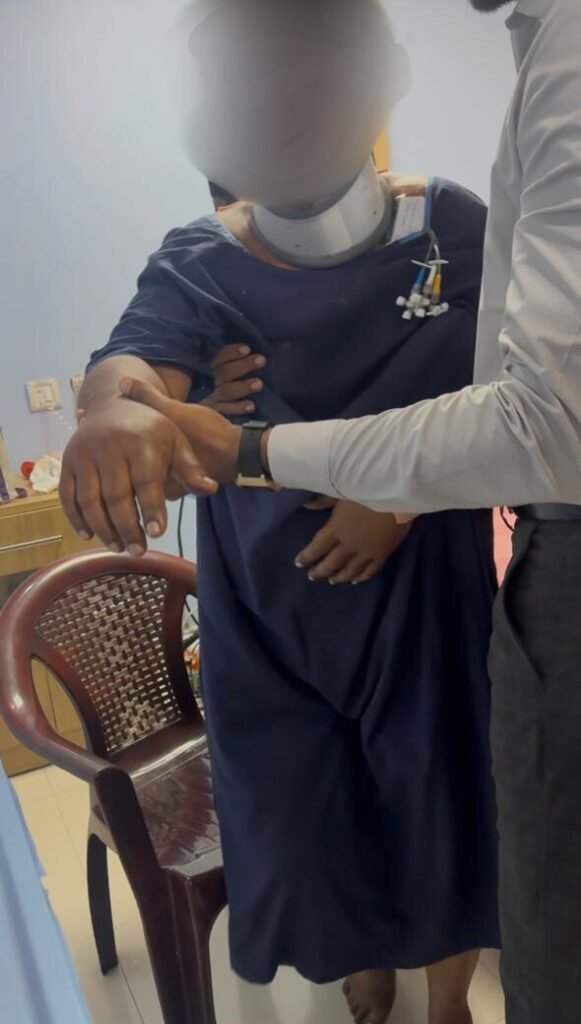
The same patient who arrived unable to move all four limbs – stood up and walked the very next day. For a spine surgeon, these are the moments that define why we do what we do. For the patient and family, it was nothing short of miraculous.
Why Did He Recover?
Several factors may have helped:
- Early surgical decompression (even after 1 week)
- Likely cord edema rather than irreversible myelomalacia
- Effective posterior decompression allowing cord drift
- Immediate mobilization and aggressive rehabilitation
Spinal cord injuries are unpredictable — but when decompression is timely and adequate, the cord can surprise us.
The Bigger Message
- OPLL can remain silent for years.
- Minor trauma can cause catastrophic neurological injury in stenosed canals.
- Early recognition and surgical decompression can dramatically alter outcomes.
- Never underestimate the recovery potential of the spinal cord.
A Reminder to Everyone
If you experience:
- Hand clumsiness
- Difficulty with fine motor tasks
- Neck stiffness with imbalance
- Electric shock sensations in arms or legs
Seek evaluation early.
Sometimes the warning signs are subtle — until they’re not.
–This article is for educational purposes and reflects clinical experience in managing complex cervical spine injuries.
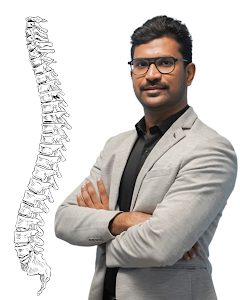
– Dr. Ganesh Kumar, MBBS, MS (Orthopedics), Post-doctoral Fellowship in Spine Surgery, FASSI (New Delhi), AO Endoscopic Spine Fellow (Germany), Robotic Spine Surgery Fellow (Italy)


We are extremely thankful to Dr. Ganesh, Orthopedic & Spine Surgeon, for the excellent care and treatment he provided to my 65-year-old mother.
My mother had a serious fall in the bathroom around 2 AM and suffered a fracture in her right leg. She was immediately admitted to Mehta’s Hospital, Velappanchavadi, where the necessary investigations were done. After reviewing her reports, Dr. Ganesh explained the condition clearly and advised surgery as the best option for a faster and safer recovery. He performed the surgery by placing a rod from her knee to her thigh, and she was discharged within five days.
Since my mother’s other leg was mildly affected by polio, mobility was extremely difficult after surgery. Dr. Ganesh patiently guided us regarding complete bed rest, exercises, wound care, recovery time and physiotherapy. He was also extremely understanding of the difficulties we faced in bringing her to the hospital for follow-ups.
What impressed us most was his availability and genuine concern. Whenever we had doubts, he was reachable by phone or WhatsApp and responded patiently, even when he was abroad. When we were unable to bring my mother for a review, he advised us to just share the X-Ray report in whatsapp. So we took home X-ray and he reviewed the report remotely, advising us on the medicines and next steps. He never suggested unnecessary tests or treatments and always explained everything clearly.
He also recommended an injection to support bone growth, which helped significantly. With his guidance and physiotherapy, after about three and a half months, my mother was able to walk with a walker and eventually started walking independent by herself.
For the first time in our experience, the patient went for her review only after three months of surgery. When we took my mother for her first review, she was already able to walk on her own.
Throughout her recovery, Dr. Ganesh guided us patiently over the phone regarding every aspect of her care—from suture removal, home X-ray, exercises, medicines, injections, and other precautions. He was always available to guide us whenever we had any doubts or concerns.
My mother had a highly comfortable and speedy recovery, and we truly believe it was possible because of his expertise, constant guidance, and genuine care for his patient.
Dr. Ganesh is not only an excellent surgeon but also a very kind, approachable and compassionate doctor. His patience, accessibility and personal attention made us feel as though we were speaking to a family member rather than a doctor.
My mother’s recovery has been a huge relief for our entire family, and we are truly grateful to Dr. Ganesh for everything he has done.
Thank you so much, Sir, for your excellent treatment, constant guidance and genuine care. Highly recommended! 🙏



I had my spinal surgery under his care, and everything went smoothly. He was very supportive and made me feel comfortable throughout the process. I’m really thankful to him for his care and guidance. Highly recommended!!!!!






I thank him very much
Dr R Prabu



The spine operation was successfully performed, and 8 screws were fixed. After the surgery, my mother is doing very well and is now able to walk.
We are extremely thankful to Dr. Ganesh Kumar sir and the entire team at Dr. Mehta’s Hospital, Velappanchavadi, for their excellent treatment, care, and support.
Highly recommended.
Thank you so much Dr. Ganesh Kumar sir.

I highly recommend Dr Ganesh Kumar for any back pain and spinal cord related issues.





I highly recommend Dr Ganesh, Spine Surgeon

Thank you Dr. Ganesh
https://www.instagram.com/dr_ganesh_kumar_spine_surgeon?igsi=MWU2ZDB0OHQxbWdiYw%3D%3D&utm_source=qr